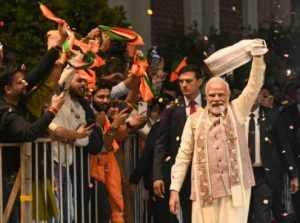
NDA Triumphs in Bihar Assembly Elections
Patna/New Delhi: The National Democratic Alliance (NDA) achieved a significant victory in the Bihar Assembly elections on Friday, reinforcing Prime Minister Narendra Modi’s popularity and Chief Minister Nitish Kumar’s sustained appeal, while delivering a setback to the Congress and its ally, the RJD.
The NDA’s success is evident as its primary members, the BJP and JD(U), are projected to secure over 85% of the seats they contested, aiming for a ‘200 paar’ win, which would grant them a three-fourths majority. According to the latest updates around 9:30 PM, the BJP is anticipated to emerge as the largest party.
Prime Minister Modi celebrated the NDA’s victory, stating that the people of Bihar have shown their unwavering confidence, effectively taking the state by storm.
The BJP’s seat count rose to 87 from 74 in 2020, while Nitish Kumar’s JD(U) increased its tally to 78 from 43. The majority threshold in the 243-member Assembly is set at 122, with the BJP and JD(U) leading in two and seven additional seats, respectively.
In contrast, the RJD’s representation fell to 24 from 75, and the Congress managed to secure only six out of the 61 seats it contested, down from 19. The RJD is currently leading in one seat.
Prime Minister Modi praised the NDA’s substantial win, introducing a new ‘MY – Mahila and Youth’ formula, which he claimed has replaced the ‘communal MY formula of the jungle raj people.’
Referring to the RJD’s traditional Muslim-Yadav support base, Modi emphasized that the recent victory has established a new, positive ‘MY – Mahila and Youth’ formula.
Overcoming anti-incumbency sentiments, Chief Minister Kumar expressed gratitude to the citizens for their overwhelming support, which he described as a ‘landslide’ victory for the NDA.
Kumar acknowledged the people’s confidence in his government, thanking voters through a post on social media, and also expressed appreciation for Prime Minister Modi’s ongoing support.
The NDA’s victory can be attributed to a combination of state and central welfare initiatives, including financial assistance to women, reminders of the ‘jungle raj’ during RJD’s governance, and the effectiveness of a ‘double-engine’ government.
The NDA’s broader caste coalition successfully undermined the Mahagathbandhan’s core voter base, with various welfare programs aimed at Economically Backward Class (EBC) households, significant backing from women supporting the liquor ban, and strong engagement from young voters contributing to the alliance’s success. Notably, there was a remarkable turnout of women voters.
The NDA also performed well in constituencies with significant Muslim populations, indicating a potential shift in voting patterns.
Prashant Kishor’s Jan Suraaj Party (JSP), considered an ‘X factor’ in the elections, failed to make an impact despite a vigorous campaign addressing issues like unemployment and industrial decline.
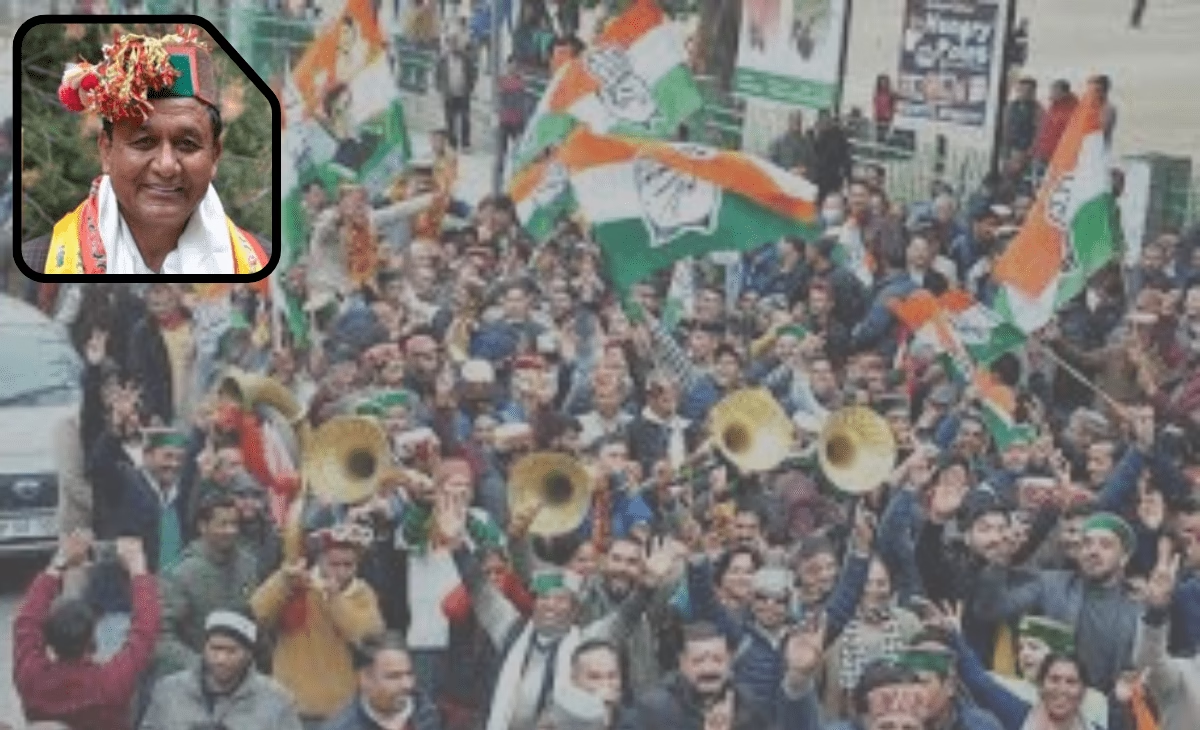
Celebrations erupted at the BJP and JD(U) offices in Patna, with party workers playing drums, setting off fireworks, and chanting slogans in honor of their leaders.
At the chief minister’s residence, JD(U) party workers posed for photos with posters proclaiming ‘Tiger Abhi Zinda Hai,’ a phrase that encapsulates Kumar’s determination to remain active in politics.
Kumar, who has served as Bihar’s chief minister for nine terms, faced speculation about his health and potential anti-incumbency fatigue but proved his critics wrong with this election.
In the lead-up to the elections, Kumar, known as ‘sushasan babu’ (man of good governance), implemented various benefits, including increased social security pensions and financial support for women through the ‘Mukhyamantri Mahila Rojgar Yojana,’ which has provided over one crore women with Rs 10,000 each.
Kumar did not contest this election directly, opting instead for the legislative council route to maintain his position.
The BJP’s performance solidifies its status as a leading political force in India, countering any setbacks from the previous year’s Lok Sabha elections, where it relied on allies to maintain power.
The NDA’s success in Bihar follows impressive performances in Delhi, Maharashtra, and Haryana, with the BJP winning 132 of the 149 seats it contested in Maharashtra last year. The strong support from Modi and his ministers during the campaign also significantly benefited the JD(U).
The LJP(RV), led by Union minister Chirag Paswan, managed to win 18 seats despite contesting with only 28 candidates, as one of its nominations was rejected.
Union minister Jitan Ram Manjhi’s Hindustani Awam Morcha and Rajya Sabha MP Upendra Kushwah’s Rashtriya Lok Morcha, both minor partners in the NDA, secured five and four seats, respectively, after contesting six seats each. The BJP relied on these allies to consolidate Dalit support.
The Mahagathbandhan, which includes the RJD, Congress, and three Left parties, suffered a significant defeat, despite polls indicating Tejashwi Yadav as a favored candidate for chief minister.
Yadav, who was initially trailing, managed to secure a victory in Raghopur, defeating BJP candidate Satish Kumar by 14,532 votes.
The Mahagathbandhan struggled to maintain its traditional strongholds, as the Muslim-Yadav (MY) coalition, which has historically supported the RJD, faltered.
The Congress faced a humiliating defeat, often viewed as a ‘weak link’ in the INDIA bloc.
Rahul Gandhi’s campaign against the BJP, centered around allegations of ‘Vote Chori’ (vote theft), failed to resonate with voters.
The AIMIM, led by Hyderabad MP Asaduddin Owaisi, won five seats despite contesting 32, often criticized as a ‘B-team’ of the BJP.
The NDA’s victory in the Bihar elections, conducted in two phases amid allegations of electoral roll irregularities, is seen as a precursor to upcoming Assembly elections in West Bengal and Assam scheduled for the next six months.