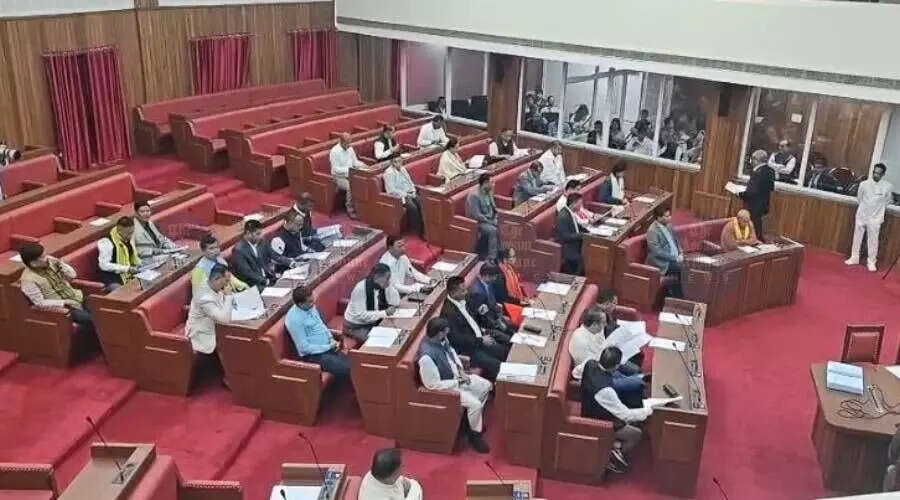
Winter Session Begins
Kokrajhar/Bijni, Dec 1: The Bodoland Territorial Council (BTC) initiated its two-day Winter Session on Monday, focusing on various critical governance and development matters within the Bodoland Territorial Region (BTR).
Personnel Shortages Highlighted
A significant topic of discussion was the severe lack of personnel in essential departments. Currently, there are 300 vacant gazetted positions in Grade I and II, with the health sector alone needing 150 doctors.
Representatives emphasized that the BTR’s status as a malaria-prone area heightens the urgency to fill these medical vacancies.
Concerns Over Infrastructure
Derhasat Basumatary, the BPF chief whip and BTC Executive Member, pointed out ongoing issues with Bodoland University, the medical college, and BSc Nursing colleges, particularly regarding their infrastructure. He noted that Tamulpur district still lacks essential administrative buildings, from district to sub-divisional offices, necessitating focused discussions on these matters.
Bodo Peace Accord Implementation
UPPL MLA Daobaisa Boro raised questions about the new BTC administration’s commitment to implementing all aspects of the Bodo Peace Accord. He stated, “We have raised significant issues for the community and want to know if the new council will adhere to all Accord clauses.” BTC chief Hagrama Mohilary assured that the government would review these clauses before proceeding.
Inclusive Representation in Council
To promote inclusive representation, six individuals from various communities have been nominated as Members of the Council Legislative Assembly (MCLA). The nominees include Karmeshwar Roy (Rajbongshi), Ratan Chandra Rabha (Rabha), Nand Lal Magar (Gorkha), Hemprabha Devi (Koch), Ajay Kumar Hazarika (Kalita), and Ridip Kumar Deka (Sarania Kachari).
Political Tensions Rise in Bijni
Outside the Council hall, political tensions escalated in Bijni as 22 Koch-Rajbongshi leaders and workers resigned collectively from the UPPL, expressing dissatisfaction with the party’s lack of responsiveness to their demand for Scheduled Tribe (ST) status.
Shankar Barman, vice-president of the Bijni District Youth Cell, stated, “Today, workers and officials from the entire Bijni district resigned together. We appreciate the Assam government for including Koch-Rajbongshi in the ST report. However, due to UPPL’s opposition to this decision, we decided to leave. This resignation movement will persist.”
Protests and Administrative Response
This wave of resignations followed significant protests by tribal students on November 29, who opposed the state government’s decision to grant ST status to six additional communities. The situation intensified when protesters stormed the BTC Secretariat, damaging the main gate and vandalizing parts of the Assembly House.
In reaction, the Kokrajhar district administration enforced Section 163 of the Bharatiya Nagarik Suraksha Sanhita (BNSS) on Sunday, limiting public movement and gatherings in the Secretariat Complex and surrounding areas.
Chief Secretary Ravi Kota and senior officials from various Assam government departments participated in discussions aimed at enhancing administrative efficiency and addressing persistent gaps in essential services.