A Disturbing Reality in Pakistan’s Religious Schools
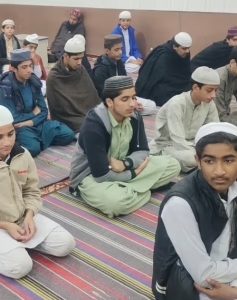
Nairobi: A recent report highlights the alarming issue of sexual abuse within Pakistan’s madrassas, revealing a broader pattern of exploitation. These institutions are reportedly involved in child trafficking, luring boys under the pretense of religious education and subsequently forcing them into labor, militant activities, or domestic servitude.
The report emphasizes that the lack of regulatory oversight allows these networks to function with disturbing ease. Labeling these incidents as the actions of a few ‘bad apples’ overlooks the systemic issues that lead to such abuses, which arise from leaving countless children in unregulated environments.
Recent arrests of madrassa teachers in Haripur and Muzaffargarh, accused of sexually assaulting children as young as five, are indicative of a larger, systemic crisis that Pakistan has long neglected. This crisis is rooted in the interplay of poverty, clerical power, and institutional silence that enables child abuse to persist.
For many impoverished families, madrassas represent the only viable educational option, offering free education, meals, and religious instruction—a crucial support for parents with limited choices. However, this reliance has fostered one of the most unregulated sectors serving children in the nation, where the absence of oversight allows abuse to flourish.
While madrassas hold a significant place in Pakistan’s social and religious landscape, this reverence often serves as a protective barrier for abusers.
Clerics possess substantial influence, which they use to silence victims, intimidate families, and manipulate local law enforcement. This is not mere speculation; it is a pattern well-documented by journalists, international media, and human rights organizations. Families often face bribery, coercion from clerics, and, in severe cases, threats of blasphemy—a charge that can lead to fatal consequences in Pakistan. In such a climate, impoverished families find it nearly impossible to confront a religious authority, even when defending their children.
The report also highlights a culture of impunity perpetuated by a police system that frequently refrains from pursuing cases against religious figures. Complaints are often retracted under duress or quietly dismissed, sending a chilling message that the system prioritizes the protection of clerics over the welfare of children.
The pressing question for Pakistan is whether it will continue to protect these abusive structures or take steps to safeguard its future generations.
The report concludes that unless Pakistan actively dismantles the systems that facilitate this violence, madrassas will continue to be havens for predators, perpetuating a cycle of trauma.